Along Spain’s sun-soaked southeast coast, the fragile waters of the Mar Menor are under mounting pressure from years of agricultural and urban pollution. Now, researchers are testing a floating 3D-printed sensor designed to track contaminated water in real time—an innovation that could transform how authorities respond to environmental threats.
A Floating Guardian for a Vulnerable Ecosystem
The new monitoring device was developed by engineers at the Catholic University of Murcia (UCAM). Their goal is to create an always-on electronic system that measures both the quality and flow of water entering the lagoon.
Unlike traditional monitoring, which relies heavily on periodic sampling, this modular unit can sit directly in canals and drainage channels feeding the Mar Menor. By doing so, the team hopes to detect pollution spikes the moment they occur.
The regional government has committed €80,000 through its Directorate-General for the Mar Menor to support the project. At the heart of the device is an electrochemical sensor tuned to detect nitrates—one of the lagoon’s most damaging pollutants.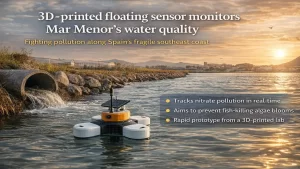
Spanish Scientists Unveil 3D Tool Tracking Mar Menor Pollution
Why Nitrates Are a Major Threat
Nitrates mainly originate from fertilisers used across the intensive farming region of the Campo de Cartagena. When excess nutrients wash into the lagoon, they fuel rapid algae growth.
This process can:
Deplete oxygen in the water
Trigger massive fish die-offs
Disrupt tourism and local fisheries
Damage sensitive wetland habitats
The Mar Menor, Europe’s largest coastal saltwater lagoon, is particularly vulnerable because it sits downstream from highly productive agricultural land and is separated from the Mediterranean by a narrow sandbar.
Critical Entry Points Under Watch
Researchers are focusing their field validation on two key pollution pathways:
Canal D7, a major drainage channel carrying mixed agricultural runoff
Rambla de El Albujón, an intermittent stream capable of delivering sudden pollutant surges during rainfall
By monitoring these hotspots, scientists hope to detect contamination before it spreads throughout the lagoon.
How the 3D-Printed Sensor Works
The system converts chemistry into data. Its electrochemical core changes electrical signals based on nitrate concentration in the surrounding water.
What makes the project especially promising is the custom 3D-printed housing:
Designed to float or anchor in shallow channels
Easily modified if field conditions change
Cheaper to produce than traditional equipment
Scalable for wider deployment
Before installation, the team carefully calibrates the sensor in the laboratory using controlled nitrate solutions. Only after confirming accuracy do they test it with real water samples from the lagoon’s drainage network.
From Measurements to Rapid Action
Officials hope the sensors will eventually feed live data into Murcia’s broader environmental monitoring systems, which already include satellite observations, citizen reports and manual sampling.
Real-time information could allow authorities to respond much faster. Instead of waiting weeks for lab results, they could act within hours by:
Temporarily restricting irrigation flows
Increasing inspections at specific farms
Activating emergency aeration in high-risk zones
Adjusting water-management policies
Why Each Metric Matters
| What the sensor tracks | Why it matters |
|---|---|
| Nitrate concentration | Drives algal blooms and oxygen loss |
| Surface water flow | Shows how much pollution enters during storms |
| Long-term trends | Measures whether mitigation efforts are working |
Science Meets Regional Policy
Murcia’s regional government views the project as a bridge between research and practical environmental management. Officials, including Environment councillor Juan María Vázquez, have emphasized the need for data-driven decisions to restore the lagoon.
For UCAM researchers, the Mar Menor has become a real-world testing ground. The devices must withstand heat, saltwater, waves and even potential vandalism while continuing to transmit reliable readings.
The team plans to present its progress internationally, including at scientific meetings in Stockholm, to compare methods with other groups studying polluted lakes, estuaries and wetlands.
Why 3D Printing Is Changing Environmental Monitoring
The growing use of 3D printing in environmental engineering offers several key advantages:
Custom shapes: Devices can fit narrow canals or shallow waters
Rapid iteration: Failed prototypes can be redesigned within days
Local production: Units can be manufactured near deployment sites
Lower costs: Scaling up becomes far more affordable
These benefits allow regional governments and smaller research teams to build sensor networks that once required major national funding.
Challenges Still Ahead
Despite its promise, the technology faces practical hurdles:
Biofouling from algae and sediment can affect sensors
Batteries and communications must remain reliable long-term
Data must connect to clear response protocols
Technology alone cannot enforce pollution reduction
In short, sensors can reveal when contamination occurs—but policy and agricultural practices must ultimately deliver the recovery.
A Test Case for Coastal Restoration
If successful, the Mar Menor project could serve as a model for other vulnerable lagoons and estuaries worldwide. Similar low-cost modules might one day monitor phosphates, heavy metals or pesticide traces in rivers and coastal waters.
For local residents, the real measure of success will be visible: clearer water, fewer algal blooms and the absence of mass fish die-offs that have shaken public confidence in recent years.
The floating 3D-printed sentry may be small, but it represents a larger shift toward continuous, data-driven protection of fragile coastal ecosystems.
FAQ
What problem is the new sensor trying to solve?
It aims to detect nitrate pollution entering the Mar Menor in real time, helping authorities respond faster to harmful discharges.
Why are nitrates dangerous for the lagoon?
Excess nitrates fuel algal blooms that consume oxygen in the water, which can lead to large fish kills and ecosystem damage.
How is this different from traditional monitoring?
Traditional methods rely on periodic sampling. The new device provides continuous, near-real-time data directly from pollution entry points.
Why use 3D printing for the device?
3D printing allows rapid design changes, lower production costs and easier scaling if multiple sensors are deployed.
Could this technology be used elsewhere?
Yes. Similar sensors could monitor other pollutants in rivers, reservoirs and coastal wetlands if the Mar Menor trials prove successful.