For almost a decade, one technology enthusiast has quietly powered much of his home using hundreds of discarded laptop batteries—transforming electronic waste into a functioning energy storage system and dramatically reducing his reliance on the traditional power grid.
From E-Waste to Energy Independence
The project began in November 2016. Already experimenting with rooftop solar panels and an aging forklift battery, he wanted to expand his storage capacity. However, new lithium battery systems were far beyond his budget.
Instead of buying new equipment, he turned to something familiar: old laptops.
Modern laptops rely on lithium-ion battery packs. When a device is scrapped, only one or two internal cells are often faulty—while the remaining cells still retain usable capacity. Recognizing this, he started collecting discarded batteries from repair shops, recycling centers, and online listings.
Today, he has gathered more than 1,000 used laptop batteries. Many of the viable cells now form a large, homemade energy storage system that captures solar power for daily household use.
“I’ve basically built a giant power bank for my house,” he explains.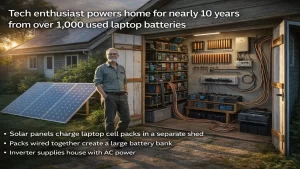
Recycled Laptop Batteries Power Home — DIYers — Lower Costs
A Battery Farm Hidden in a Shed
The core of the system sits inside a separate shed about 50 meters from the house. This distance is intentional. Lithium-ion batteries can pose fire risks if mishandled, so isolating the installation from living spaces adds an important safety buffer.
Inside the shed:
Shelves hold battery packs assembled from salvaged cells
Solar panels feed charge controllers
Controllers charge grouped battery packs
Heavy copper cables connect the packs into a larger bank
An inverter converts stored DC electricity into standard 230/120V AC
Monitoring tools track voltage, temperature, and charge levels
He initially built packs rated at around 100 ampere-hours (Ah). Multiple packs are then wired together to create a large, modular storage system.
Though it may look improvised, each pack is labeled, fused, and individually tested. If one fails, it can be disconnected without shutting down the entire installation.
How Old Laptop Batteries Get a Second Life
A typical laptop battery contains several cylindrical lithium-ion cells. When a laptop battery “dies,” often just one weak cell drags down the entire pack.
He carefully opens the casing and tests each cell:
| Cell Condition | Action Taken |
|---|---|
| Good capacity, stable voltage | Used in main house battery packs |
| Reduced capacity but safe | Used in low-demand projects |
| Swollen, unstable, damaged | Sent for proper recycling |
Each usable cell is charged, discharged, and tested before installation. This slow, methodical approach has allowed the system to operate for years without major incidents.
Importantly, he never pushes the batteries to their limits. By cycling them between moderate charge levels—rather than fully draining them—he reduces stress and extends lifespan.
Ten Years of Second-Hand Electricity
The system now supplies a significant portion of his home’s daily power needs. During sunny days, solar panels charge the batteries. At night, the stored energy powers lights, computers, and many appliances.
He still maintains a grid connection as backup for extended cloudy periods, but his electricity bills have fallen sharply. Rising energy prices affect him far less than most households.
For him, the project is more than technical experimentation—it is a response to waste and increasing energy costs.
Costs and Practical Limitations
While many batteries were acquired free or cheaply in bulk, the system itself required investment:
Solar panels
Inverter
Charge controllers
Monitoring equipment
Fuses and disconnect switches
Heavy copper wiring
The biggest cost, however, has been time. Testing hundreds of cells and assembling safe battery packs demands patience and technical knowledge.
He does not claim this is a plug-and-play solution for everyone—but rather proof that creative reuse is possible.
Safety Risks and Regulatory Questions
Lithium-ion batteries can be dangerous if mishandled. Risks include short circuits, overheating, and fire.
To minimize danger, he:
Installs fuses on every pack
Uses disconnect switches
Provides ventilation
Monitors temperature and voltage
Locates the system in a separate shed
Even so, regulations can be unclear. In many regions, home-built battery systems fall into gray areas of electrical codes and insurance policies. In the event of a fire, insurers may question compliance with recognized safety standards.
Anyone considering a similar approach must understand these risks.
A Growing Trend: Second-Life Batteries
While this project focuses on laptops, the broader concept is gaining momentum globally.
Electric vehicle batteries, for example, often lose capacity for automotive use but remain suitable for stationary storage. Companies and utilities are increasingly developing “second-life” systems that repurpose used EV batteries for homes and grid stabilization.
This small backyard installation reflects the same idea—just at a personal scale.
What It Means for Everyday Households
Most people will never build a shed filled with 650+ battery packs. But the story highlights important shifts:
Energy storage is becoming central to home solar systems
Lithium-ion technology underpins both laptops and commercial home batteries
Falling prices are making storage more accessible
Reuse and sustainability are gaining importance
Certified, commercially available home battery systems offer safer, regulated alternatives. However, this project demonstrates how discarded technology can be given meaningful new life when handled carefully.
Key Concepts Behind the System
Ampere-hour (Ah): Measures battery capacity. A 100 Ah pack can theoretically deliver 10 amps for 10 hours.
Inverter: Converts direct current (DC) from batteries into alternating current (AC) used by household appliances.
Depth of Discharge: Draining batteries completely shortens lifespan. Limiting use between moderate charge levels extends durability—especially important for second-life cells.
Together, these principles show how careful engineering and patience can transform electronic waste into long-term energy storage.
Conclusion: Reuse, Risk and the Future of Home Energy
This decade-long experiment proves that discarded laptop batteries can power a home when managed cautiously and systematically. It highlights both the promise and the risks of second-life energy storage.
As solar adoption rises and battery costs continue to fall, more households will consider adding storage—whether through certified products or innovative reuse.
The bigger message? What we throw away may still hold value, especially in an era of rising energy demand and sustainability concerns.
Frequently Asked Questions (FAQs)
1. Is it safe to power a home with old laptop batteries?
It can be dangerous if not handled properly. Lithium-ion cells require testing, fusing, ventilation, and monitoring. Improper assembly can cause fires.
2. How much money can this type of system save?
Savings depend on electricity prices, solar output, and system size. In this case, grid reliance dropped significantly, lowering monthly bills.
3. Why not just buy a commercial home battery?
Commercial systems are safer and certified but expensive. This project prioritizes low cost and reuse, though it requires technical skills.
4. How long do second-life batteries last?
When operated within moderate charge ranges, they can last several additional years before final recycling.
5. Are there legal issues with homemade battery systems?
In some regions, building a custom battery bank may conflict with electrical codes or insurance requirements. Always check local regulations before attempting such a project.