The heat doesn’t just make you sweat. It makes your electricity meter spin faster.
Across hot cities, air conditioners roar day and night, pushing indoor heat outside and pulling power from already strained grids. But a new generation of rooftop technology is offering a different approach — one that cools buildings by sending heat upward, not blasting it sideways.
Instead of fighting the heat with bigger compressors, these systems use physics that has always been there: the sky itself.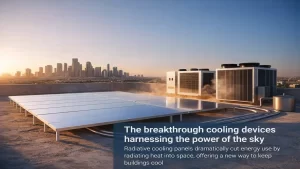
New Cooling Tech — Families — Cuts Power Use Dramatically
Cooling by Pointing at Space
Radiative cooling panels don’t look like traditional air conditioners. There’s no bulky compressor, no humming outdoor unit. Instead, they appear as sleek, reflective panels installed on rooftops.
Their function is surprisingly simple:
They reflect nearly all incoming sunlight, preventing heat absorption.
They emit heat from the building as infrared radiation.
That infrared energy passes through a natural “atmospheric window” and escapes into outer space.
Every object releases heat in the form of infrared radiation. Normally, Earth cools itself this way at night. Radiative cooling devices enhance that natural process — even during daylight.
In field tests, some prototypes have cooled circulating water by 5–10°C below the surrounding air temperature while using minimal electricity beyond a small pump.
The key difference? They don’t just move heat around. They send it away.
Why This Matters for Energy Bills
Traditional air conditioners rely on refrigerant compression cycles, which consume large amounts of electricity and expel hot air into the surrounding environment. That contributes to urban heat buildup and higher peak demand on power grids.
Radiative cooling panels work upstream. By lowering the baseline temperature of water or surfaces before conventional AC engages, they reduce the total cooling load.
Studies from universities and independent laboratories suggest potential cooling energy reductions of 20–60% in favorable climates when radiative panels are used as a pre-cooling stage.
In practical terms, that could mean:
Shorter AC run times
Smaller compressor units
Lower peak electricity demand
Reduced strain during heatwaves
The biggest impact appears in hot, dry regions with clear skies, where infrared radiation can escape most efficiently.
How Homes and Buildings Use It Today
Radiative cooling systems are typically installed on rooftops, similar to solar panels. They connect to a simple water loop:
Water circulates behind the cooling panel.
Heat radiates into the sky.
Cooled water returns to the building.
That cooled water can feed:
Radiant floor systems
Fan coil units
Storage tanks
Pre-cooling stages before standard AC
Most experts emphasize a hybrid approach. Radiative cooling is not designed to eliminate air conditioning entirely in most homes — at least not yet. Instead, it acts as a partner system that reduces the heavy lifting required from traditional units.
Where It Works Best (And Where It Doesn’t)
Climate plays a major role.
Ideal Conditions:
Hot, dry climates
Clear summer skies
Good roof exposure
Buildings with hydronic (water-based) systems
Less Effective Conditions:
Cloudy coastal regions
High humidity areas
Buildings without water circulation systems
In humid environments, the atmospheric “window” that allows infrared heat to escape becomes partially blocked by water vapor. That limits cooling performance.
Before investing, homeowners should evaluate:
Roof orientation
Structural support
Local weather patterns
Compatibility with existing HVAC systems
Like any emerging technology, success depends on proper application.
Beyond One Device: A Smarter Cooling Strategy
Radiative cooling panels are part of a broader shift in building design. Instead of relying solely on mechanical force, modern energy strategies layer multiple passive and active tools:
Reflective or “cool” roofing materials
Better insulation and shading
Smart window glazing
Efficient heat pumps
Thermal storage tanks
Smaller, optimized AC systems
The long-term goal isn’t to eliminate comfort — it’s to reduce the energy required to maintain it.
As power grids face increasing strain from extreme heat, reducing peak demand becomes just as important as lowering individual bills.
What This Means for Future Summers
Cities are getting hotter. Air conditioners are running longer. Electricity demand spikes during the exact hours when cooling is most needed.
Radiative cooling technology suggests a quieter alternative — one where buildings release excess heat upward instead of dumping it into already overheated streets.
The technology is still evolving. Costs are shifting. Not every roof is ready. But the principle is clear: the coldest place accessible to us isn’t underground or in a machine — it’s outer space.
And in certain climates, tapping into that natural heat sink could reshape how homes stay comfortable during extreme heat.
Key Points
| Key Point | Detail | Value for Readers |
|---|---|---|
| Uses Space as a Heat Sink | Reflects sunlight and emits infrared heat upward | Explains why it needs far less electricity than AC |
| Works Best as a Partner | Reduces AC load by 20–60% in some climates | Cuts bills and extends AC lifespan |
| Climate Matters | Strongest in dry, clear-sky regions | Helps homeowners avoid costly mistakes |
FAQs
What exactly is a radiative cooling panel?
It’s a rooftop device made from specially engineered materials that reflect sunlight while emitting heat as infrared radiation. That heat escapes through the atmosphere into space, cooling the panel and any connected system.
Can it fully replace my air conditioner?
In most existing homes, no. It’s best used alongside conventional AC to reduce workload and energy consumption, particularly in hot, dry climates.
Does it work during the day?
Yes. Advanced materials reflect visible sunlight while emitting infrared radiation, allowing cooling even under direct sun.
How much energy could I realistically save?
Field studies report potential cooling energy reductions between 20% and 60% in suitable climates, especially when combined with insulation and efficient HVAC systems.
Is it suitable for older homes?
Possibly. Some systems are designed as rooftop add-ons that connect to water-based cooling loops. Compatibility depends on your building’s structure and existing equipment.
Does humidity affect performance?
Yes. High humidity and persistent cloud cover reduce efficiency because water vapor absorbs some infrared radiation before it escapes to space.