A practical cleaning tip is gaining attention across household forums and social media. The idea is surprisingly simple: adding a small amount of salt to dishwashing liquid can improve its cleaning performance.
While modern dish soaps are designed to remove grease, many people still encounter common problems such as stubborn food residue, lingering odours, and greasy film on dishes. In many cases, the issue is not the detergent itself but the conditions in which it is used.
Hard water, burnt food, and thick layers of oil can make it harder for dish soap to work efficiently. A basic ingredient already found in most kitchens—table salt—can help tackle these situations.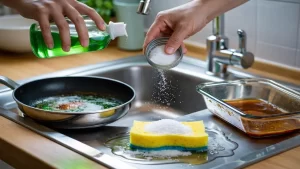
Simple Salt Hack — For Dishwashing — Solves a Common Kitchen Cleaning Problem
Why Dishwashing Liquid Sometimes Struggles
Even high-quality dishwashing liquids can have difficulty with certain types of residue. Several factors contribute to this problem.
Hard water reduces cleaning efficiency
Minerals in hard water can limit how well detergents interact with grease and food particles.
Burnt or dried food sticks firmly to surfaces
When food dries or burns onto cookware, soap alone may not break the bond easily.
Thick grease forms stubborn layers
Oils and fats can cool and solidify on pans, trays, and containers, making them harder to remove.
In these cases, adding a small amount of salt can enhance the cleaning process.
How Salt Improves the Cleaning Power of Dish Soap
Salt plays two helpful roles during washing: it adds mild abrasion and helps loosen grease.
Gentle scrubbing action
Fine salt crystals act as a light abrasive. They help remove dried sauces, cheese, coffee stains, and other residue without requiring heavy scrubbing.
Compared with harsh scouring powders, salt offers a softer friction that can be safer for many kitchen surfaces when used properly.
Helping soap break down grease
Salt can also influence how water interacts with oily films. This can make it easier for detergent molecules to surround and lift grease away from dishes.
As a result, many people notice:
Faster grease removal
Less slippery residue on plates
Reduced odours on plastic containers
Salt does not replace dishwashing liquid—it supports the detergent’s action, especially on stubborn grime.
How to Add Salt to Your Dishwashing Routine
There are two simple ways to use salt while washing dishes.
1. Mix salt directly into your dish soap bottle
This method enhances your detergent continuously.
Steps:
Use fine table salt for better dissolution.
Add 1–2 tablespoons of salt to a 500 ml bottle of dishwashing liquid.
Close the bottle tightly and shake gently.
Use the soap normally during dishwashing.
Some users find that the mixture becomes slightly thicker, which helps the soap cling to sponges and greasy surfaces.
2. Apply salt directly to stubborn areas
Salt can also be used only where extra cleaning power is needed.
| Problem | How to use salt |
|---|---|
| Burnt food in pans | Sprinkle salt on the surface, add hot water and dish soap, wait 10–15 minutes, then scrub. |
| Greasy baking trays | Remove excess fat, add salt and dish soap, then scrub with a sponge. |
| Smelly plastic containers | Add salt, dish soap and warm water, close and shake before rinsing. |
This targeted method provides extra scrubbing where grease or residue has hardened.
Surfaces Where Salt Works Best
Salt works well on many common kitchen materials.
Suitable surfaces include:
Stainless steel pans and pots
Glass baking dishes
Ceramic plates and bowls
Metal baking trays without non-stick coatings
Stainless steel sinks (when used with water and soap)
The mild abrasive effect helps clean these surfaces without significant damage when used carefully.
Surfaces That Require Caution
Some kitchen items are more delicate and should not be scrubbed with salt aggressively.
Use caution with:
Non-stick cookware
Cast iron pans (avoid soaking in salty water)
Marble or natural stone countertops
Decorated china with metallic finishes
Always test a small hidden area first and use a soft sponge rather than a harsh scrubber.
Why This Tip Appeals to Many Households
With rising household costs, many people are looking for simple ways to reduce spending on cleaning products.
Salt is:
inexpensive
widely available
already present in most kitchens
By helping dish soap work more effectively, salt may allow households to use slightly less detergent over time, which can reduce cleaning costs.
Although salt itself has environmental impacts through mining and transport, it remains a low-tech alternative to specialized chemical boosters.
Realistic Expectations
Salt is not a miracle cleaner. Extremely burnt or damaged cookware will still require effort and proper soaking.
It also does not function as a disinfectant at normal kitchen concentrations. Proper hygiene still depends on hot water, detergent, and thorough rinsing.
Think of salt as a support tool that helps detergents perform better rather than replacing them.
Key Takeaways
| Key Point | Explanation | Benefit |
|---|---|---|
| Salt boosts dish soap | Fine crystals add mild abrasion | Removes stubborn residue faster |
| Supports grease removal | Improves interaction between water and oil | Cleaner dishes with less effort |
| Simple household solution | Uses common kitchen ingredient | Saves money on cleaning products |
Frequently Asked Questions (FAQs)
1. Can salt damage cookware?
Fine salt used with water and dish soap is generally safe for stainless steel, glass, and ceramic. However, avoid heavy scrubbing on non-stick coatings, delicate surfaces, or marble countertops.
2. Does salt disinfect dishes?
No. Salt alone is not a reliable disinfectant. Proper cleaning still relies on detergent, warm water, and thorough rinsing.
3. Should I use coarse salt or fine table salt?
Fine table salt works best because it dissolves more easily and provides gentler abrasion. Coarse salt crystals may scratch delicate surfaces.
4. Can I mix salt with dish soap permanently?
Yes. Many people add 1–2 tablespoons of salt to a 500 ml bottle of dishwashing liquid to improve grease removal during everyday use.
5. Does this trick help remove odours from plastic containers?
Yes. Salt combined with dish soap and warm water can help reduce lingering smells in plastic food containers, especially those used for oily or strongly flavoured foods.