You’ve probably told yourself at least once, “One day I’ll rent a pressure washer and finally clean this patio.” But then you remember how heavy the machine was, how loud it sounded, and how exhausting the job felt last time.
Standing outside with a cup of coffee, looking at darkened stones or concrete, many homeowners begin to wonder whether there’s a simpler way to restore clean paths and a bright terrace—without sacrificing an entire weekend.
The good news is that there are practical, low-effort methods that can remove common patio stains using simple household solutions.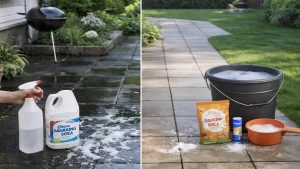
1 Easy Method to Remove Black Stains From Patios and Garden Paths — Minimal Effort
Why Patios Turn Dark Over Time
The black or greenish layer on patios rarely appears overnight. Instead, it forms gradually through a mixture of environmental elements such as:
Dust and airborne pollution
Crushed leaves and plant residue
Moisture from rain or irrigation
Grill smoke and soot
Algae, fungi, and microscopic organic growth
These substances settle into the small pores of concrete or natural stone. Over time, moisture and organic debris create a surface where microorganisms can thrive.
Light-colored materials like limestone, concrete slabs, or pale paving stones often show these changes the most.
Why Black Stains Become Difficult to Remove
Several factors allow patio stains to persist:
Moisture and Organic Material
Algae and microscopic fungi prefer damp, shaded environments—such as areas under trees, near gutters, or behind planters.
Porous Surfaces
Stone and concrete contain tiny pores that trap dirt and organic matter, allowing microorganisms to grow beneath the surface.
Surface Film
Oily particles from pollution, cooking smoke, and natural debris can create a thin film that protects the growth underneath.
Because of this, heavy scrubbing alone often fails. Even if the surface looks cleaner temporarily, the underlying organic growth can remain embedded in the material.
A better strategy is to break down the organic layer first, allowing water to rinse away the residue.
Smart Cleaning Instead of Heavy Scrubbing
Rather than relying on force, many homeowners now prefer methods that use simple chemistry to dissolve buildup naturally.
The idea is straightforward:
Apply a mild cleaning solution.
Allow time for the solution to penetrate stains.
Rinse away the loosened residue.
This approach reduces physical effort while still achieving visible results.
Easy Patio Cleaning Methods That Save Time
1. Baking Soda and Vinegar Method
This simple technique works well for light to moderate dark stains.
Steps
Choose a dry day.
Sprinkle baking soda over stained areas, especially near joints or cracks.
Spray a mixture of 1 part white vinegar and 2 parts water.
Allow the mixture to fizz and sit for 20–30 minutes.
Sweep lightly and rinse thoroughly with water.
The mild reaction helps loosen dirt trapped in small pores, often restoring brightness without heavy scrubbing.
2. Oxygen-Based Cleaner for Algae
For surfaces with stronger green or dark organic stains, sodium percarbonate (oxygen bleach) can be effective.
How to use it
Dissolve the product in warm water according to package directions.
Apply the solution evenly across the wet patio surface.
Let it sit for about 45–60 minutes.
Rinse the area thoroughly.
As the compound releases oxygen, it breaks down organic material in joints and rough stone surfaces.
Cleaning Products to Avoid
Some aggressive chemicals may deliver quick results but can damage surfaces or nearby plants.
It’s best to avoid:
Strong acids
Undiluted chlorine bleach
Harsh industrial cleaners
These substances can weaken stone, degrade grout joints, and harm surrounding garden plants.
Bringing Your Patio Back to Life
Once homeowners see how effective simple cleaning methods can be, patio maintenance becomes far less intimidating.
Instead of a demanding annual project, it becomes a manageable seasonal routine. A short cleaning session—apply, wait, rinse—can restore much of the original appearance of outdoor spaces.
Consistent light cleaning often prevents heavy buildup and reduces the need for extreme solutions later.
Practical Tips for Maintaining a Clean Patio
Use mild cleaning solutions
Choose baking soda, diluted vinegar, or oxygen-based cleaners instead of strong chemicals. These remove buildup while protecting surfaces and nearby plants.
Let the solution work first
Allow cleaning products to sit for 20–60 minutes before rinsing. This reduces the need for intense scrubbing.
Clean seasonally
A quick cleaning once or twice per season prevents stubborn stains from forming.
Protect surrounding plants
Rinse plants with water before and after treatment to prevent accidental exposure to cleaning solutions.
Conclusion
Patio stains may seem stubborn, but they usually form from gradual organic buildup rather than permanent damage. By understanding how algae, moisture, and debris interact with stone or concrete surfaces, homeowners can choose smarter cleaning methods that require far less effort.
Simple solutions—such as baking soda, diluted vinegar, or oxygen-based cleaners—can break down organic stains effectively while protecting the patio and surrounding garden. With regular seasonal maintenance, outdoor spaces can stay bright and welcoming without the need for heavy equipment or exhausting scrubbing.
Frequently Asked Questions (FAQs)
1. Why do patios turn black over time?
Patios darken because of accumulated dust, moisture, algae, fungi, and environmental pollutants that settle into porous surfaces.
2. Is pressure washing the only effective cleaning method?
No. Many stains can be removed with mild chemical reactions using household ingredients like vinegar, baking soda, or oxygen-based cleaners.
3. How often should a patio be cleaned?
Light cleaning once or twice per season is usually enough to prevent stubborn buildup.
4. Are vinegar and baking soda safe for patio stones?
When used in mild solutions and rinsed properly, they are generally safe for most stone and concrete surfaces.
5. Can strong bleach damage patio materials?
Yes. Concentrated chlorine bleach and strong acids can damage joints, fade stone surfaces, and harm nearby plants.