Seeing a scratch on a once-perfect glass cooktop can be disappointing. The sleek black surface that once looked flawless suddenly shows a pale line that catches your eye every time you enter the kitchen.
This type of scratch can happen easily. A heavy pot moved too quickly, a grain of salt trapped under a pan, or rough cookware can leave a mark on the surface. Even small scratches can feel noticeable, especially when your fingers detect a slightly rough edge.
Many homeowners immediately worry the damage is permanent or think about replacing the cooktop. However, in many cases, scratches on glass cooktops can be reduced or made far less visible with the right care and gentle polishing techniques.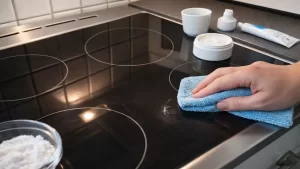 Fix Glass Stovetop Scratches Fast — Home Cooks — Restore the Surface Without Replacement
Why Glass Cooktops Get Scratches
Glass cooktops are designed to be durable and stylish. Their smooth, reflective surface gives kitchens a modern look and allows for efficient daily cooking.
However, the glass surface can still develop scratches over time. Several common factors can cause this type of damage:
Moving heavy cookware across the surface
Tiny grains of salt or food particles trapped under pans
Rough-bottomed cookware, such as cast iron
Sliding pans instead of lifting them
Often, scratches are not noticed immediately. Many people discover them later when cleaning the cooktop, which can make the damage feel more frustrating than it actually is.
The good news is that many scratches are only surface-level and can often be improved with simple polishing methods.
Step 1: Determine the Depth of the Scratch
Before trying to repair a scratch, it’s important to understand how deep it is.
Look at the scratch under bright lighting and from different angles.
Here are three common scratch levels:
Light Surface Marks
These scratches appear only from certain angles and cannot be felt with a fingernail. They are usually the easiest to improve.
Visible Lines
If your fingernail lightly catches on the mark, the scratch is slightly deeper but can still often be reduced with polishing.
Deep Grooves
If your nail clearly catches in the scratch, the damage is deeper. These scratches cannot usually be fully repaired at home but may still become less noticeable.
Understanding the scratch level helps you choose the safest method and avoid causing further damage.
Step 2: Prepare the Surface Carefully
Before attempting any repair, make sure the cooktop is completely clean.
Follow these steps:
Wipe the surface using a soft cloth and a cooktop-safe cleaner.
Remove any grease, food residue, or particles.
Dry the surface completely.
Only gentle polishing materials should be used. Good options include:
Baking soda paste (mixed with water)
Non-gel toothpaste
Ceramic cooktop cream
Glass polishing compound
These products work by gently smoothing the glass rather than grinding it down.
Always use a soft microfiber cloth when polishing. Avoid rough materials such as:
Steel wool
Abrasive sponges
Scouring pads
These can create new scratches.
Step 3: Polish the Scratch Gently
Before treating the visible scratch, test your chosen method on a small hidden area.
If the surface remains clear and undamaged, you can proceed.
For light scratches
Apply toothpaste or baking soda paste.
Rub gently in small circular motions.
Wipe clean and check the result.
Repeat if necessary.
For more noticeable scratches
Use ceramic cooktop cream or a glass polishing compound.
Apply with light pressure and polish slowly.
Patience is important. Several gentle passes are safer than applying heavy pressure.
Deep scratches may not disappear completely, but careful polishing can soften their appearance and make them less noticeable.
Step 4: Finish and Protect the Surface
After polishing, clean the area again to remove leftover product.
Many homeowners apply a specialized cooktop cleaner that leaves a light protective shine.
Finish by buffing the surface with a clean microfiber cloth until the cooktop shines evenly.
While the scratch may still exist, it is usually much less visible and blends into the surface more naturally.
Frequently Asked Questions (FAQs)
Can scratches on a glass cooktop be completely removed?
Light surface scratches can sometimes be polished away or significantly reduced. However, deep scratches usually cannot be fully removed and may only become less visible.
Is toothpaste safe for polishing a glass cooktop?
Yes. Non-gel toothpaste contains mild abrasives that can gently smooth small surface scratches when used with a soft cloth.
What should never be used on a glass cooktop?
Avoid steel wool, scouring pads, or harsh abrasive cleaners. These materials can create additional scratches and worsen the damage.
How can I prevent future scratches?
Lift cookware instead of sliding it, keep the cooktop clean of salt or debris, and avoid using rough-bottomed cookware.
When should a cooktop be replaced?
Replacement is usually only necessary if the glass is deeply cracked, chipped, or structurally damaged. Cosmetic scratches alone rarely require replacement.