Each winter across Britain and the US, gardeners rush to protect tender plants as temperatures drop. The instinct is well-meaning: cover shrubs quickly so frost can’t harm them. Yet this reflex often causes more damage than the cold ever would.
What feels like protection frequently turns into a silent killer—especially when plastic is involved.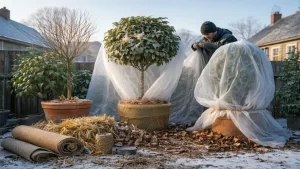
1 Costly Gardening Mistake Many Homeowners Make Every Season
The winter mistake that backfires every year
When frost warnings appear, many people reach for whatever is close at hand: bin bags, tarpaulins, bubble wrap, or leftover plastic sheeting. These materials are waterproof, sturdy, and reassuring in bad weather.
Unfortunately, they are also airtight.
Plants don’t “switch off” in winter. Even in cold conditions, they continue to respire, release moisture, and react to light and temperature. Wrapping them tightly in plastic traps moisture and heat, creating conditions that are far more dangerous than open air.
In most gardens, the real enemy isn’t frost—it’s suffocation combined with damp.
Why plastic creates a deadly microclimate
Plastic prevents air circulation. Moisture from soil and leaves builds up inside the cover, coating foliage and stems. During the day, sunlight heats the trapped air like a greenhouse. At night, temperatures plunge.
This rapid swing causes multiple problems at once:
Condensation freezes directly onto leaves and stems
Ice conducts cold more efficiently than dry air
Warm afternoons encourage sap movement, followed by hard nighttime freezes
Repeated freeze–thaw cycles rupture plant cells
Instead of gentle insulation, the plant sits inside a thin shell of ice and humidity. Damage often appears weeks later, when leaves blacken, drop, or rot away.
When “cosy” conditions lead to rot
Even plants that survive freezing temperatures face another threat under plastic: fungal disease.
Still, wet air is ideal for mould and rot. Gardeners often don’t discover the problem until spring, when covers finally come off to reveal:
Limp, brown leaves
White or grey mould
Blackened, brittle stems
A strong musty smell
Many shrubs tolerate brief frost. Few survive months of cold, damp stagnation.
The plants most at risk
The irony is that the shrubs people try hardest to protect are often the most vulnerable to poor wrapping. Mediterranean and dry-climate plants struggle in cold humidity, including:
Citrus
Oleander
Olive
Bay
Lavender
Rosemary
These species cope better with dry cold than with sealed, wet air.
What actually works in winter protection
Effective winter protection focuses on breathability, not waterproofing.
Better materials
Horticultural fleece: allows airflow while softening cold and wind
Burlap or jute: breathable, reusable, and gentle on foliage
Straw or dry leaves: excellent insulation for roots and soil
These materials insulate without sealing, acting more like a wool jumper than a raincoat.
How to cover shrubs safely
Create a loose frame with stakes around the plant
Drape breathable fabric over the frame, not directly onto foliage
Tie loosely at the base—never tightly around stems
Leave space for air circulation
The goal is a cushion of air, not compression.
When plastic can still be useful
Plastic isn’t always forbidden—it just needs careful use.
It can help:
For one night only, during an extreme frost, removed the next morning
Around pots only, insulating containers while leaving foliage exposed
Problems arise when plastic stays on plants for days or weeks without ventilation.
Early warning signs your plant is suffocating
Act quickly if you notice:
Leaves feeling clammy or slimy
Heavy condensation inside covers
A mouldy smell
Yellowing or browning leaves in mid-winter
Loosening or changing the cover early can still save the plant.
A calmer approach saves more plants
Good winter care works with plant biology, not against it. Steadier temperatures, airflow, and dry conditions protect far better than panic wrapping.
Sometimes, simply moving pots near a wall, mulching roots thickly, and using a light breathable cover achieves far better results than the familiar black plastic bag pulled on in haste.
FAQs
Q1: Is frost protection always necessary for shrubs?
No. Many established shrubs tolerate normal winter frost. Protection is most useful for young plants, tender species, or those grown in containers.
Q2: Why is plastic worse than leaving plants uncovered?
Plastic traps moisture and heat, causing freeze–thaw stress, rot, and fungal disease. Dry air is often safer than sealed dampness.
Q3: Can bubble wrap be used safely?
Only around pots or containers to protect roots. It should not wrap foliage or stems directly.
Q4: How often should winter covers be checked?
Ideally once a week. During mild spells, opening covers briefly helps dry out moisture and prevents mould.
Q5: What’s the simplest low-cost alternative to plastic?
Dry leaves or straw around the base, combined with burlap or fleece over the top, offers effective and breathable protection.
A small shift in how plants are covered can mean the difference between a thriving spring garden and empty soil where last year’s favourites once stood.