The heat arrives quietly at first. Then it lingers.
In cities like Phoenix, air conditioners hum nonstop through summer afternoons. Power meters spin faster. Electricity bills rise. And outdoor units pump hot air back into streets already struggling with extreme heat.
Now, a new generation of cooling technology is offering a different approach — one that works with physics instead of fighting it.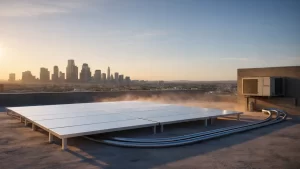
A Cooling Device That Faces the Sky
Unlike traditional air conditioners, radiative cooling systems don’t rely on bulky compressors or refrigerants. Instead, they use sleek rooftop panels engineered to reflect sunlight while releasing heat upward — directly toward outer space.
This process, known as radiative cooling, takes advantage of a natural atmospheric “window” that allows certain infrared wavelengths to escape into space. By emitting heat in that precise range, these panels can lower surface temperatures below the surrounding air — even under direct sunlight.
In controlled field tests, some prototypes cooled circulating water by 5–10°C below ambient air temperature, using only minimal electricity for a small pump.
The result: significant cooling potential without the heavy energy demand of conventional AC systems.
How Radiative Cooling Works
The principle is simple but powerful:
The panels reflect nearly all incoming sunlight, preventing heat buildup.
At the same time, they emit thermal energy as infrared radiation.
That radiation travels through a transparent atmospheric band into cold outer space.
Every object naturally emits heat. Radiative cooling devices are simply engineered to do it more efficiently — and more selectively.
Instead of venting hot air into urban neighborhoods, these systems quietly export excess heat away from the planet.
Best Used as a Partner to AC
Radiative cooling isn’t designed to eliminate air conditioning. Instead, it reduces the workload.
Here’s how it typically works:
Panels are mounted on rooftops, similar to solar panels.
Water circulates behind them in a closed loop.
The cooled water feeds radiant floors, fan coils, or pre-cools air before it enters an AC unit.
By lowering baseline temperatures first, the AC system cycles less frequently or can be downsized entirely.
Several university studies suggest energy savings between 30% and 60% in suitable climates when radiative cooling is used as a pre-cooling stage.
In hot, dry cities such as Las Vegas or Dubai, where clear skies are common, the technology shows especially strong results.
Where It Works — And Where It Doesn’t
Radiative cooling performs best in:
Dry climates
Regions with clear summer skies
Buildings with good roof exposure
Homes that use hydronic (water-based) systems
It is less effective in:
Humid coastal regions
Areas with frequent cloud cover
Buildings without water circulation infrastructure
Clouds and moisture absorb some of the infrared radiation before it escapes to space, reducing performance.
Understanding local climate conditions is critical before investing.
Why It Matters for Future Summers
Air conditioning demand is rising globally. During heatwaves, power grids are often pushed to their limits. Traditional systems also intensify the “urban heat island” effect by releasing hot exhaust air outdoors.
Radiative cooling offers a complementary strategy:
Lower peak electricity demand
Reduced strain on power grids
Smaller AC units
Longer equipment lifespan
Lower monthly energy bills
Rather than increasing machine power, the approach reduces heat at the source.
While the technology is still evolving and costs continue to shift, its potential signals a broader change: cooling buildings by collaborating with atmospheric physics instead of overpowering it.
Key Takeaways
| Key Point | Detail | Value for Homeowners |
|---|---|---|
| Uses space as a heat sink | Reflects sunlight, emits infrared heat upward | Lower electricity use |
| Works best as a pre-cooler | Reduces AC load by 30–60% in optimal climates | Smaller bills, longer AC life |
| Climate matters | Strongest in dry, clear-sky regions | Avoids unrealistic expectations |
FAQs
1. What exactly is a radiative cooling device?
It is a rooftop panel engineered to reflect sunlight while emitting heat as infrared radiation through the atmosphere’s transparent window into space, cooling itself and connected systems.
2. Can it completely replace my air conditioner?
In most homes today, no. It works best as a complementary system that reduces AC workload and energy consumption.
3. Does it only function at night?
No. Modern materials are designed to reflect sunlight and radiate heat even under direct sun, allowing daytime cooling.
4. Is this technology only for new buildings?
Not necessarily. Some systems are designed as rooftop add-ons that can integrate with existing water-based heating and cooling systems.
5. How much energy can homeowners realistically save?
Early data suggests potential cooling energy savings of 20–60%, depending on climate, building design, and integration with insulation, shading, and efficient heat pump systems.
As heatwaves intensify in cities like Phoenix, hybrid cooling solutions such as radiative panels may become an important tool for improving comfort while reducing grid pressure.