Nearly ten years after crimson streaks first appeared on a religious statue, the phenomenon is again commanding attention—this time from forensic science rather than faith. What some once hailed as a miracle is now being examined drop by drop by a judicial geneticist, as prosecutors, clergy, and pilgrims await answers that could redefine the case entirely.
From Pilgrimage Souvenir to Continental Sensation
The story traces back to Medjugorje, a world-famous pilgrimage destination in Bosnia and Herzegovina, where reports of Marian apparitions have circulated since the 1980s. During a visit, Italian woman Gisella Cardia purchased a statue of the Virgin Mary and later brought it back to Italy.
According to Cardia, the statue soon began exhibiting extraordinary behavior: shedding tears of blood, delivering divine messages, and accompanying alleged miracles such as the multiplication of food. These claims drew comparisons to well-known biblical episodes and quickly spread among the faithful.
The statue’s notoriety peaked in Trevignano Romano, a lakeside community near Rome. There, prayer gatherings grew rapidly. Pilgrims arrived by the busload, hoping to witness signs, seek healing, or simply record what they believed to be a divine event.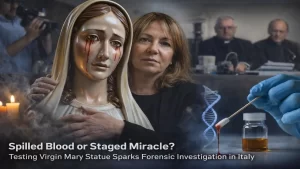
3 DNA Findings on a Weeping Statue — What It Means Today
A Visionary at Odds With Church Authorities
As Cardia’s following expanded, so did scrutiny. She publicly identified herself as a visionary entrusted with urgent messages and apocalyptic warnings. Catholic authorities, known for their caution with supernatural claims, began monitoring the gatherings closely.
When donations and media attention increased, civil authorities stepped in. Prosecutors in Civitavecchia opened an investigation, suspecting that the blood might not be miraculous at all—but staged.
Pig Blood, Then a Startling Reversal
Initial rumors suggested the blood could be animal in origin, possibly from a pig. That claim alone shook many believers. But subsequent reporting by Corriere della Sera revealed a dramatic turn.
Laboratory tests linked to University of Tor Vergata reportedly identified the substance as female human blood. Even more striking, the genetic profile appeared to closely match Cardia herself.
This finding reframed the case: Was the blood applied deliberately, unconsciously, or through some unexplained process?
The DNA Analysis That Could Decide the Case
Authorities have now ordered an expanded forensic examination. A judicial geneticist is tasked with determining whether the blood traces come from a single individual or a mixture of multiple DNA sources.
Single match: Prosecutors may argue the blood was self-applied.
Mixed profile: The situation becomes more complex, possibly involving multiple contacts.
Results are due on 28 February, a pivotal date that could determine whether charges proceed. While courts will not rule on miracles, they will rule on fraud—specifically whether believers were misled into giving money or devotion under false pretenses.
Defense Position: Faith, Not Deception
Through her lawyer, Solange Marchignoli, Cardia denies wrongdoing. The defense portrays her as a woman of modest means acting purely out of religious conviction. According to her legal team, she remains focused on prayer and trusts that the investigation will clear her of criminal intent.
Why Claims Like This Keep Returning
The Trevignano case is far from unique. Reports of bleeding statues and weeping images have emerged repeatedly across continents. Several forces help explain their persistence:
Emotional need: People seek tangible signs during uncertain times.
Social influence: Belief spreads more easily once a few witnesses speak out.
Media amplification: Local events can become national stories overnight.
Charismatic leadership: A compelling figure can sustain belief for years.
Because of these dynamics, official Church recognition of miracles is rare and often takes decades—if it happens at all.
When Forensic Science Meets Faith
In this case, tools usually reserved for crime scenes are being applied to a religious object:
Sample collection: Careful swabbing to avoid contamination
DNA extraction: Isolating genetic material from dried traces
Profile comparison: Matching DNA with known individuals
Mixture analysis: Determining whether multiple contributors are present
For believers, the process may feel intrusive. For investigators, it is simply verification.
Between Belief, Psychology, and Proof
Psychologists note that expectation and suggestion can strongly shape perception. In emotionally charged settings, ordinary events may be remembered as extraordinary. This neither proves nor disproves faith claims—but it explains why experiences can feel profoundly real to those involved.
Practical advice for readers encountering similar stories includes:
Checking transparency around donations
Seeking independent verification
Considering the stance of established religious authorities
Allowing room for both belief and critical thought
Conclusion & FAQs
As the DNA deadline approaches, attention is fixed on what science will reveal—not about the divine, but about human action. The findings could mark the end of a modern Marian devotion or the beginning of a courtroom battle over alleged deception.
Frequently Asked Questions
What exactly is being tested?
Investigators are analyzing the DNA in the blood-like substance to determine its origin and whether it matches one or more individuals.
Will the test prove or disprove a miracle?
No. Courts do not judge supernatural claims. The test only addresses whether there was human involvement or potential fraud.
Why does a DNA match matter legally?
If the blood matches a single individual closely, prosecutors may argue it was deliberately applied, supporting fraud allegations.
Has the Church recognized this event as a miracle?
No official recognition has been granted, and Church authorities have urged caution.
What happens after the results are released?
Prosecutors will decide whether to proceed with charges or close the case based on the forensic findings.