You water carefully. You check the forecast. You even add a little mulch. Then two scorching days pass, and suddenly your once-lush garden looks brittle and exhausted. Seedlings collapse. The soil cracks. Compost turns dusty.
When you dig a few centimeters down, the ground feels lifeless and powdery.
The problem often isn’t just heat — or even water. It’s what your soil is missing beneath the surface.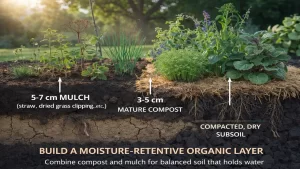
Fast-Drying Garden The Soil Layer You May Be Missing
The Invisible Layer That Holds Everything Together
Healthy soil behaves like a sponge. After rain in a forest, the ground feels soft and cool. Beneath the surface lies a dark, crumbly layer rich in organic matter that stores moisture and feeds life below ground.
Many home gardens lack this structure.
Instead, there’s:
A thin top layer of soil
Compacted, dry subsoil underneath
Water that runs off, evaporates, or drains too quickly
Without a moisture-retentive organic layer, soil becomes like a leaky bucket. You pour water in, and it disappears before roots can use it.
This missing middle zone — where compost, minerals, air, microbes, and roots interact — is what keeps gardens resilient during heat.
Why Watering More Doesn’t Always Work
When soil is compacted or low in organic matter:
Water sits near the surface
Evaporation increases
Roots stay shallow
Plants stress faster during heatwaves
Frequent light watering can make this worse. It encourages surface roots and prevents deeper moisture storage.
The solution isn’t constant irrigation. It’s rebuilding soil structure.
How to Rebuild a Moisture-Holding “Sponge” Layer
Think of your garden bed like layered lasagna, not a blended smoothie. Layering organic matter over time builds long-term resilience.
Step 1: Loosen, Don’t Flip
Gently loosen the top 10–15 cm with a fork. Avoid turning the soil upside down, which disrupts roots and beneficial organisms.
Step 2: Add Mature Compost
Spread 3–5 cm of dark, fully decomposed compost. It should smell earthy, not sour. Compost improves structure and water retention.
Step 3: Mulch Generously
Add 5–7 cm of organic mulch:
Shredded leaves
Straw
Dried grass clippings
Wood chips
Mulch reduces evaporation and protects the compost layer below.
Step 4: Water Deeply
Water less often, but thoroughly enough that moisture reaches 20–30 cm down. Deep watering trains roots to grow deeper.
Step 5: Repeat Seasonally
One layer helps. Repeated layers over seasons build a durable, sponge-like structure.
Common Mistakes to Avoid
Using decorative bark alone without compost underneath
Adding large amounts of sand to “improve drainage”
Tilling deeply every season
Light daily watering instead of deep irrigation
Improvement comes from consistency, not quick fixes.
What Changes Once Soil Improves
After several months of consistent layering:
Soil feels cool and crumbly below the surface
Rain absorbs instead of pooling
Plants maintain thicker, stronger leaves
Watering frequency decreases
Heat stress becomes less dramatic
The garden becomes more stable — not immune to drought, but far less fragile.
Why This Matters Long-Term
A well-built organic layer does more than store water. It:
Buffers temperature swings
Encourages earthworms and microbial life
Improves root penetration
Reduces runoff
Supports stronger plant growth
The real shift happens when you stop trying to “fix plants” and start building soil.
Key Takeaways
| Action | Why It Matters | Benefit |
|---|---|---|
| Build a compost + mulch layer | Increases water retention | Less frequent watering |
| Loosen, don’t till deeply | Protects soil structure | Healthier roots |
| Water deeply, not daily | Encourages deep rooting | Stronger drought resistance |
| Repeat seasonally | Builds long-term soil health | Lasting resilience |
Conclusion
If your garden dries out quickly despite regular watering, the issue may lie beneath the surface. Soil without a moisture-retentive organic layer cannot store water effectively.
By gently loosening soil, adding compost, mulching generously, and repeating the process season after season, you create a living sponge beneath your plants. Over time, watering becomes more efficient, plants grow stronger, and your garden handles heat with far greater resilience.
Growing soil — not just plants — is the long-term answer to dry, struggling beds.
Frequently Asked Questions (FAQs)
Why does my soil dry out so fast even when I water often?
Shallow watering combined with low organic matter leads to rapid evaporation and poor moisture storage at root depth.
How thick should mulch be?
A layer of 5–7 cm works well. Too thin won’t protect soil; too thick can suffocate seedlings if placed directly against stems.
Can I use fresh grass clippings as mulch?
Yes, but apply them in thin, partially dried layers. Thick, wet clumps can become compacted and limit airflow.
How long does it take to improve dry soil?
You may notice improvement within one season, but meaningful structural change typically takes 1–3 years of consistent organic layering.
Will I still need to water?
Yes, but less frequently. Deep watering combined with improved soil structure reduces overall irrigation needs.