This summer in the Baltic Sea, a small fleet of French underwater robots has taken center stage in one of NATO’s most advanced unmanned warfare experiments. Quiet, autonomous, and powered by artificial intelligence, these gliders are reshaping how the alliance listens beneath the waves.
French Gliders Stand Out in NATO’s Baltic Trials
Since June 2025, NATO’s Allied Command Transformation has led Task Force X Baltic (TFXB), a large-scale exercise testing aerial drones, surface vessels, and autonomous submarines in one of Europe’s most strategically sensitive waters.
Among the systems deployed, five SEAEXPLORER units built by ALSEAMAR have drawn particular attention. Operating independently for weeks at a time, the gliders collect acoustic intelligence and transmit near real-time insights into NATO networks.
The Baltic Sea—shallow, busy, and close to Russian naval infrastructure—provides a realistic environment to test how unmanned systems perform under pressure.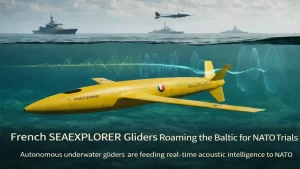
New French Spy Glider Impresses NATO — Baltic Trials
How the SEAEXPLORER Moves Without a Motor
Unlike traditional submarines or underwater drones, SEAEXPLORER gliders have no propellers.
Instead, they rely on buoyancy-driven propulsion:
A pump shifts oil between internal and external chambers.
By becoming slightly heavier than water, the glider sinks.
Wings convert that downward motion into forward glide.
When lighter than water, it rises—again gliding forward.
This slow zigzag pattern consumes minimal energy. The result is endurance measured in weeks or even months, covering thousands of kilometers on a single battery.
By sacrificing speed, the gliders gain persistence—one of the most valuable assets in modern maritime surveillance.
Onboard AI: Listening Before Reporting
The real innovation is not just mechanical efficiency but onboard intelligence.
Each SEAEXPLORER can be equipped with AURIS, an artificial intelligence system designed for acoustic analysis. Rather than transmitting raw sound data for later review, the glider processes information internally.
It can:
Analyze underwater acoustic signals in real time
Filter out background noise
Recognize specific sound signatures such as propellers or sonar pings
Send only relevant alerts to command centers
This approach reduces satellite bandwidth use and speeds up decision-making. Operators receive qualified intelligence within minutes instead of hours.
Why the Baltic Sea Matters
The Baltic Sea has become one of NATO’s most closely monitored regions. It borders several alliance members and lies near key Russian naval facilities. The seabed hosts vital infrastructure, including energy pipelines, communication cables, and major trade routes.
Persistent underwater monitoring supports deterrence by ensuring movements beneath the surface do not go unnoticed.
Instead of deploying large crewed vessels for constant patrol, NATO can distribute networks of autonomous sensors that quietly observe and report anomalies.
From Ocean Science to Defense Technology
Originally developed for civilian oceanography, SEAEXPLORER gliders have been used to measure:
Temperature and salinity
Pollution levels
Ocean currents
Biological activity
Their dual-use design makes them adaptable for defense missions such as anti-submarine support and maritime surveillance.
Founded in 2015 as part of the ALCEN group, ALSEAMAR specializes in buoyancy materials, acoustic systems, and compact underwater technologies—skills that translate directly into military applications.
France’s Strategic Message to NATO
Beyond the hardware, the Baltic trials carry political weight.
France is demonstrating that its autonomous systems integrate seamlessly with American, British, and German platforms under NATO command structures. Interoperability—data sharing, network compatibility, and standardized procedures—is as critical as endurance or depth capability.
If the exercise proves successful, it could pave the way for joint programs and export opportunities as allied navies seek cost-effective, lower-risk surveillance solutions.
How SEAEXPLORER Compares Globally
France is not alone in developing underwater gliders. Several American systems operate worldwide for both research and defense purposes.
SEAEXPLORER’s competitive edge lies in its modular sensor integration and embedded AI processing, allowing advanced acoustic filtering directly onboard rather than relying entirely on shore-based analysis.
What This Means for Future Conflicts
Autonomous gliders offer multiple advantages:
Reduced risk to human crews
Lower fuel and operational costs
Continuous surveillance regardless of weather
Scalable deployment in large numbers
However, challenges remain:
Risk of misclassification in noisy waters
Cybersecurity vulnerabilities
Legal ambiguity when operating near sensitive infrastructure
In a potential future crisis, swarms of gliders could be dispatched to monitor suspected submarine activity, narrowing search zones before crewed ships or aircraft are committed.
The Baltic exercise demonstrates a shift toward quieter, data-driven naval operations—where machines not only collect information but decide what matters before a human ever hears a sound.
FAQs
1. What is SEAEXPLORER?
SEAEXPLORER is a French-built autonomous underwater glider developed by ALSEAMAR for oceanographic research and maritime surveillance.
2. How does the glider move without a propeller?
It changes buoyancy to sink and rise, using wings to convert vertical movement into forward glide, consuming very little energy.
3. What role does artificial intelligence play?
The onboard AURIS system processes acoustic data in real time, filtering noise and identifying relevant sound signatures before transmitting alerts.
4. Why is the Baltic Sea significant for NATO?
The region contains critical infrastructure and lies near strategic naval routes, making underwater monitoring essential for deterrence and security.
5. How could these gliders change naval operations?
They enable persistent, low-cost surveillance while reducing risks to human crews, potentially transforming how alliances monitor and respond to underwater threats.