The United States Navy is quietly advancing plans for a massive autonomous submarine known as OEX, a crewless underwater platform designed to patrol the oceans for weeks at a time and potentially deliver heavy payloads across thousands of kilometres. If realised, it would mark one of the most radical shifts yet in how naval power is projected beneath the sea.
A silent giant without sailors
Despite being labelled a “drone,” OEX more closely resembles a compact attack submarine with no humans on board. Early concepts describe a vessel between 30 and 50 metres long, weighing an estimated 40 to 70 tonnes. There are no bunks, no food stores and no life-support systems—only propulsion, batteries, sensors and a large modular payload bay.
The guiding idea is blunt: remove the crew, extend endurance, increase payload capacity and accept higher risk. OEX is envisioned as a crewless attack submarine that can be deployed deep into contested waters and, if necessary, sacrificed without the loss of life.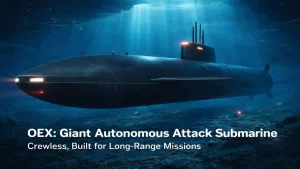
New Autonomous Submarine — Military Strategists — Stealth Warfare Shift
A modular underwater workhorse
Rather than being built for a single task, OEX is designed as a long-range undersea “truck.” Its internal bays could be reconfigured to carry very different mission packages, including:
Large explosive charges or intelligent naval mines
Intelligence, surveillance and reconnaissance sensors
Electronic listening systems to track ships and submarines
Tools to monitor, map or interfere with undersea cables
By swapping payloads and software, the same hull could shift from intelligence gathering to mine-laying or seabed operations without major redesign.
A fast-tracked development push
The programme is being driven by the Office of Naval Research, which launched an industry competition in June 2025. Companies have been asked to submit full designs, cost estimates and plans for rapid prototyping.
The process is structured in three stages:
Initial studies and cost analysis
Development of an early operational prototype
Definition of basing, maintenance and data-link infrastructure
Key milestones already point to urgency:
Pre-study submissions: July 2025
Detailed proposals: October 2025
Programme launch: 2026
Such an accelerated timeline suggests strong political backing and reflects growing concern over strategic competition in the Indo-Pacific.
Weeks underwater with minimal human input
Endurance is central to the OEX concept. The submarine is meant to submerge, disappear and operate for weeks—possibly longer—without resupply or regular contact with human controllers.
OEX fits into a “distributed” naval doctrine, where combat power is spread across many smaller, harder-to-track platforms instead of a few large, vulnerable ships. The goal is persistence and uncertainty: an adversary never quite knows what is operating beneath the surface.
AI-assisted autonomy, not remote control
Technically, OEX is expected to rely on hybrid propulsion, likely combining batteries with diesel or another system to recharge during long missions. Artificial intelligence and advanced automation would manage navigation and mission execution.
Once deployed, the submarine would follow pre-approved plans while adapting to currents, obstacles and threats. Human operators would define boundaries and rules, but the platform itself would make many real-time decisions without constant oversight.
Removing the crew changes everything: more space for fuel and sensors, fewer constraints on endurance and a far higher tolerance for risk.
Building on earlier unmanned subs
OEX does not start from scratch. It builds on lessons from earlier US programmes, including Orca, developed by Boeing, and Manta Ray, led by Northrop Grumman.
Sea trials off California in 2024 demonstrated that large autonomous underwater vehicles can manage power, navigation and long deployments under real operational conditions—clearing the path for something as ambitious as OEX.
Indo-Pacific focus and strategic intent
US planners see OEX-type submarines as especially valuable in high-risk regions, with particular attention on waters around China and Taiwan. Potential missions include:
Persistent surveillance in the South China Sea
Long-term intelligence gathering near key chokepoints
Deployment of smart mines along likely invasion routes
Monitoring undersea communication cables
Because these submarines operate quietly and without visible patrols, they enable constant presence without overt escalation.
A step toward “attritable” fleets
Beyond technology, OEX reflects a deeper shift in naval thinking. Autonomous submarines reduce risk to sailors, lower long-term operating costs and allow for missions that would be politically or militarily unacceptable for crewed vessels.
Strategists increasingly describe such platforms as “attritable”: valuable enough to matter, but affordable enough to lose. In future conflicts, undersea warfare may involve swarms of autonomous subs—some armed, some purely observational—constantly probing contested waters.
Risks, law and unresolved questions
The advantages come with serious challenges. Control and cybersecurity are major concerns for an autonomous submarine carrying explosives far from its operators. Legal and ethical questions also loom, as international maritime law was not written with AI-driven strike platforms in mind.
Determining responsibility for mistakes becomes far more complex when decisions are shared between humans and algorithms.
Frequently Asked Questions (FAQs)
What is the OEX submarine?
OEX is a planned large autonomous submarine designed to operate without a crew for weeks, carrying modular payloads for military missions.
Why remove the crew entirely?
Eliminating sailors increases endurance, frees space for fuel and payloads, lowers operating costs and allows higher-risk missions without endangering lives.
Is OEX remotely controlled?
No. It is intended to operate with high levels of autonomy, following pre-approved mission plans while making many real-time decisions on its own.
What missions could it perform?
Possible roles include surveillance, mine-laying, electronic listening and monitoring undersea infrastructure such as cables.
When could OEX enter service?
If development stays on schedule, early prototypes could appear after 2026, with operational testing following soon after.
Why does this matter strategically?
OEX supports a shift toward distributed naval warfare, making it harder for adversaries to track, deter or neutralise US undersea operations.