Moments after activation, bursts of 40 mm rounds rip through incoming target drones, destroying them mid-air before they can threaten a simulated base. That scenario captures the core mission of France’s RAPIDFire Land system, a new mobile air-defence solution designed to counter the surge of low-cost drones reshaping modern battlefields.
Built for the drone era
RAPIDFire Land represents France’s latest response to small, agile aerial threats that often slip past traditional air-defence networks. Developed by Thales Group and KNDS France, the system combines an ultra-mobile anti-aircraft cannon with advanced sensors.
Its primary role is to protect military bases, convoys and forward units from drones, loitering munitions and short-range missiles that are difficult to intercept efficiently with classic surface-to-air weapons. By doing so, the system fills the gap between shoulder-launched missiles and heavy long-range air-defence batteries.
Recent conflicts in Ukraine, the Middle East and the Sahel have demonstrated how swarms of inexpensive drones can locate and strike forces lacking tight, close-range protection. French planners have drawn heavily on those lessons.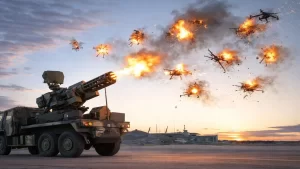
French Auto Cannon Upgrade — Base Defenders — Stronger Anti-Drone Shield
Closing a critical air-defence gap
France already operates man-portable missiles such as the Mistral and longer-range intercept systems. What was missing was a highly responsive, short-range layer capable of handling tiny quadcopters and fast kamikaze drones.
RAPIDFire Land is engineered to engage targets up to roughly 4 km in altitude at short horizontal ranges. This creates a protective “bubble” over sensitive sites including air bases, ammunition depots and radar stations. The system can also deploy alongside mechanised brigades to shield moving forces.
Its focus is the low-altitude threat band where many recent drone attacks have succeeded.
Modular design for flexible deployment
Engineers designed the system with a modular architecture so forces can match the platform to their mission.
Two main configurations are available:
Mobile version: mounted on a 6×6 or 8×8 tactical truck for high mobility with combat units
Semi-mobile version: housed in a 20-foot ISO container for fixed-site protection
The truck-mounted variant can travel with armoured columns or supply convoys and reposition within minutes as the front line shifts. The containerised version can be installed at airfields, logistics hubs or ports and later redeployed without a specialised vehicle fleet.
This “same weapon, different chassis” approach allows both static facilities and manoeuvre forces to use a common defensive tool.
Precision firepower against small targets
At the heart of RAPIDFire Land is a modern 40 mm CTA cannon using telescoped ammunition, in which the projectile sits inside the propellant casing to save space and weight.
The gun fires at roughly 200 rounds per minute. Although slower than some Cold War anti-aircraft cannons, its ammunition is far more precise and efficient—particularly against small drones.
Ammunition tailored for swarms
The linkless carousel holds about 140 rounds and supports multiple munition types:
High-explosive rounds for fragile aerial targets
Armour-piercing rounds for light vehicles or small boats
Programmable airburst shells for micro-drones and FPV threats
The programmable airburst round (often referred to as A3B) detonates at a calculated point near the target, releasing a cloud of fragments. Instead of requiring a direct hit on a tiny quadcopter, the cannon creates a controlled fragmentation zone that significantly increases kill probability while conserving ammunition.
Near-autonomous detection and engagement
RAPIDFire Land is designed to keep crews protected. The turret is unmanned, with operators working under armour inside the vehicle or from a sheltered position in the container version.
An integrated optronic sensor suite provides continuous situational awareness:
Thermal imaging for night operations
Daylight TV camera for identification
Laser rangefinder for precise distance measurement
Automatic target-tracking software
The system can operate independently or connect to broader command-and-control (C2) networks to receive targeting data from external radars and sensors. This flexibility allows it to function either as a standalone defender or as part of layered air defence.
Firing on the move
One of RAPIDFire Land’s most notable capabilities is firing while the vehicle is in motion. Many traditional short-range air-defence systems must stop and stabilise before engaging, creating moments of vulnerability.
By maintaining fire on the move, RAPIDFire Land can continuously protect advancing troops or withdrawing convoys, preserving a moving defensive envelope rather than a fixed protective ring.
The unmanned turret also lowers the vehicle’s profile and improves survivability.
France’s deployment roadmap
The French Ministry of Armed Forces has already progressed beyond the concept phase. Through the Direction générale de l’armement, France ordered an initial batch of 48 RAPIDFire Land units.
Programme timeline
| Step | Estimated date |
|---|---|
| Official order signed | January 2025 |
| Pre-series deliveries | December 2025 |
| Initial operational deployment | March 2026 |
| Full operator training | Summer 2026 |
| First export contracts | From late 2026 |
Early trials reportedly show strong performance against fast, low-flying FPV drones—one of the most challenging modern threats.
Export ambitions and NATO positioning
Industry partners aim to market RAPIDFire internationally. A naval variant already exists and has been demonstrated to potential customers in the Middle East.
By offering a common 40 mm platform usable on land and at sea, France hopes allied nations could standardise ammunition, logistics and training. The broader goal is to establish a de facto NATO-wide solution for counter-drone defence in the short-range category.
Real-world impact on base and convoy protection
In practical deployments, RAPIDFire Land could sit near an airbase runway, continuously scanning approach corridors. If a drone swarm appears, the system can engage before the aircraft or fuel depots are threatened.
Mounted within a convoy, the truck version could protect both front and rear vehicles, coordinating with electronic-warfare systems that jam drone control links.
Within a layered defence network, the concept is:
Jamming at longer range
Missiles for larger aerial threats
RAPIDFire’s 40 mm fire as the final close-in shield
Benefits and potential risks
Gun-based counter-drone systems offer several advantages:
Lower cost per engagement than missiles
Large onboard ammunition capacity
Versatility against drones, light vehicles and small boats
However, kinetic interception always produces fragments, requiring careful positioning—especially near populated areas. Adversaries are also likely to adapt by flying lower, faster or from unexpected directions.
Future air defence will probably combine electronic warfare, decoys, missiles and possibly directed-energy weapons such as high-energy lasers. For now, France is betting that a mobile 40 mm cannon provides one of the most practical near-term solutions to the drone threat.
FAQs
What is RAPIDFire Land designed to do?
It is a short-range air-defence system built to destroy drones, loitering munitions and low-flying threats that traditional missile systems may struggle to intercept efficiently.
How far can RAPIDFire Land engage targets?
The system is designed to hit targets up to about 4 km in altitude at short horizontal ranges, creating a protective bubble over units and installations.
What makes its ammunition effective against drones?
Programmable airburst rounds detonate near the target and release fragments, increasing hit probability against very small drones.
Can RAPIDFire Land operate while moving?
Yes. One of its key advantages is the ability to fire on the move, allowing continuous protection for advancing or retreating forces.
When will the system enter service?
Initial operational deployment is planned for March 2026, with full training expected by summer 2026.