The moment you notice it, it becomes impossible to ignore. A faint, pale line stretches across the sleek black surface of your glass cooktop. Perhaps it appeared after moving a heavy pan too quickly, or maybe a tiny grain of salt or sugar was trapped under a pot.
Even when the scratch is small, it tends to draw your attention every time you step into the kitchen. When you gently run your finger across the spot, you might feel a slight roughness. That’s when the questions begin:
Is the damage permanent?
Do you need to replace the cooktop?
Or is it just a minor cosmetic mark?
Fortunately, many glass cooktop scratches are superficial and can often be improved with simple household solutions.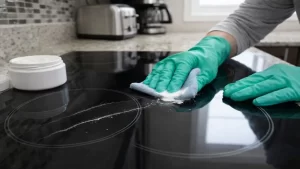
3 Easy Steps — Remove Scratches from Glass Cooktops at Home — Fast DIY Solution
Why Glass Cooktops Get Scratched
Glass cooktops are popular for their modern appearance and smooth cooking surface. They are built to be durable, but they are not completely scratch-proof.
Even careful users may eventually notice fine marks on the surface. Some of the most common causes include:
Sliding cookware instead of lifting it
Tiny grains of salt or sugar under a pot
Heavy cast-iron cookware with rough bottoms
Cleaning with abrasive tools
Interestingly, many scratches are not obvious at first. They often appear later when the cooktop is cleaned and examined under bright lighting.
The good news is that most scratches are purely cosmetic and do not affect how the cooktop functions.
How to Check the Depth of the Scratch
Before attempting any repair, it’s important to understand how deep the scratch is.
Use strong lighting and look at the cooktop from different angles. You can also lightly run your fingernail across the line.
Generally, scratches fall into three levels:
Light surface haze
Only visible under certain lighting
Fingernail does not catch on it
Usually easy to polish away
Visible surface lines
Slightly noticeable in normal lighting
Nail may catch lightly
Can often be reduced with polishing
Deep grooves
Clearly visible and easy to feel
Nail catches strongly
Hard to remove completely without professional help
Identifying the scratch type helps you choose the safest repair method.
Preparing the Cooktop Before Repair
Before trying any scratch-removal method, make sure the cooktop is perfectly clean.
Follow these simple steps:
Turn off the cooktop and let it cool completely.
Use a cleaner made specifically for glass cooktops.
Wipe the surface with a soft cloth to remove grease, dust, and spills.
Allow the surface to dry fully.
Always use gentle materials during the repair process.
Recommended tools include:
Microfiber cloth
Baking soda paste
Non-gel toothpaste
Ceramic hob cream
Glass polishing compound
Avoid steel wool, abrasive pads, or rough sponges, as these can create more scratches.
Easy Ways to Reduce Cooktop Scratches at Home
Before applying any solution to the scratch itself, test the method on a small hidden area first.
1. Baking Soda Paste
Mix baking soda with a small amount of water to form a paste.
Gently rub the mixture onto the scratch using small circular motions with a microfiber cloth. After polishing for a short time, wipe the area clean and check the results.
2. Non-Gel Toothpaste
Plain toothpaste can act as a mild polishing compound.
Apply a small amount to the scratch and polish gently with a soft cloth. This method may require a few attempts to see visible improvement.
3. Ceramic Hob Cream
Products designed specifically for glass cooktops are often more effective for moderate scratches.
Apply a small amount and polish carefully. These cleaners are formulated to restore shine while smoothing the glass surface.
4. Glass Polishing Compound
For multiple scratches or more noticeable marks, a glass polishing compound can provide stronger results.
However, it should be used carefully to avoid removing too much of the surface finish.
Scratch Repair Methods Comparison
| Method | Best For | Advantages | Possible Drawbacks |
|---|---|---|---|
| Baking Soda Paste | Small surface scratches | Cheap and easy household solution | Not effective for deep scratches |
| Non-Gel Toothpaste | Light visible scratches | Mild polishing ability | May require repeated applications |
| Ceramic Hob Cream | Light to moderate scratches | Designed for glass cooktops | Slightly more expensive |
| Glass Polishing Compound | Multiple or stubborn scratches | Stronger polishing effect | Must be used carefully |
How to Restore the Cooktop’s Shine
After reducing the scratch, clean the cooktop once again to remove any residue.
Many homeowners use a specialized glass cooktop cleaner that leaves a glossy protective layer. Using a dry microfiber cloth, gently buff the surface until the reflection appears smooth and even.
While the scratch may still exist, it often becomes much less noticeable.
Tips to Prevent Future Scratches
Daily habits can make a big difference in protecting your glass cooktop.
Follow these simple precautions:
Always lift cookware instead of sliding it
Check the bottom of pans for debris before placing them down
Clean salt, sugar, and food spills quickly
Avoid extremely heavy cookware with rough bases
Only use cooktop-safe protective mats
These small changes can help maintain the cooktop’s smooth surface for years.
When a Cooktop May Need Replacement
Sometimes a scratch may actually be the start of a crack.
Stop attempting home repairs if you notice:
The scratch spreading over time
A deep groove that catches your nail strongly
A line that begins to resemble a crack
Structural damage can weaken the cooktop and may create safety risks when heat is applied. In these cases, a professional inspection is the safest option.
Conclusion
Glass cooktops bring a sleek and modern look to any kitchen, but daily cooking can eventually leave small marks behind. In most cases, scratches are purely cosmetic and do not affect the cooktop’s performance.
By identifying the type of scratch and using gentle polishing methods, many marks can be reduced or blended into the surface. Combined with careful daily habits, these simple solutions can keep your cooktop looking smooth, clean, and shiny for years.
Frequently Asked Questions (FAQs)
1. Can scratches on a glass cooktop be completely removed?
Light surface scratches can often be polished away or significantly reduced. Deep scratches, however, may only become less noticeable rather than fully disappearing.
2. Is it safe to keep using a scratched glass cooktop?
Yes, most minor scratches are cosmetic and do not affect safety. However, deep scratches that resemble cracks should be inspected by a professional.
3. Does toothpaste really help remove scratches from glass cooktops?
Non-gel toothpaste contains mild abrasives that can gently polish the surface and reduce the appearance of light scratches.
4. What should never be used on a glass cooktop?
Avoid steel wool, abrasive pads, harsh chemicals, or rough scrubbers, as these can create additional scratches.
5. How can I prevent scratches in the future?
Always lift cookware instead of sliding it, clean spills quickly, check pan bottoms for debris, and use cookware with smooth bases.