The first truly cold morning never sends a warning in advance.
You walk outside, and your car looks perfectly normal—until the dashboard lights up with that yellow tire symbol.
Instant worry: Did I pick up a nail… or is it just the cold?
At gas stations everywhere, drivers cluster around stiff air hoses, cold fingers tapping phone screens to check tire sizes. Some add a little extra air “just to be safe.” Others drive off, hoping the warning light will disappear.
Most people believe they understand winter tire care.
Swap the tires, add air, and move on.
But tire professionals keep repeating one simple pressure rule—
…and most drivers still miss it.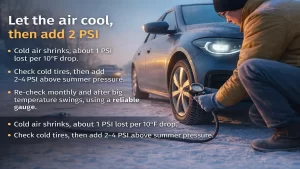
1 Winter Tire-Pressure Rule Drivers Often Forget — This Season
The Winter Pressure Rule Hiding in Plain Sight
Ask any tire technician what happens when temperatures drop and you’ll hear the same answer: cold air contracts.
When the temperature falls, tire pressure falls too.
As a rough guide:
Every 10°F (5–6°C) drop = about 1 PSI lost
So the pressure you set on a mild autumn afternoon is not the pressure you’ll have when deep winter arrives.
The result?
Tires become slightly underinflated
Steering feels less precise
Braking distances can increase on cold, wet roads
The expert advice isn’t complicated or high-tech. It comes down to this:
In winter, you often need slightly higher tire pressure—and you must recheck it when real cold weather arrives.
A Common Winter Scenario
Picture a driver—let’s call her Mia.
In October, she sets her tires to the recommended 32 PSI on a pleasant 60°F day.
By January, the morning temperature drops to 20°F.
Her tire warning light suddenly appears.
She assumes a slow leak.
At the tire shop, the technician checks:
Front tires: 27–28 PSI
Rear tires: 27–28 PSI
No puncture. No damage.
Just physics.
Because the temperature fell more than 30°F, the pressure naturally dropped several PSI. Multiply this across millions of vehicles, and you get a widespread but often unnoticed winter safety issue.
What Experts Actually Recommend
Many drivers know they should check pressure “regularly,” but winter requires more precision.
Professionals generally advise:
Set pressure to the manufacturer’s recommendation when tires are cold
Base the reading on your true winter outdoor temperature
After winter settles in, consider adding 2–4 PSI above the summer setting
Never exceed the maximum pressure printed on the tire sidewall
Why the balance matters:
Underinflated tires: overflex, wear faster, reduce control
Overinflated tires: lose grip on ice and rough winter roads
This isn’t guesswork. It’s routine maintenance.
How to Apply the Rule Without Overthinking
Car experts often suggest a simple winter habit.
Step 1: Find the correct pressure
Check the sticker inside the driver’s door or your owner’s manual. That number—not the gas-station default—is your baseline.
Step 2: Check when tires are truly cold
Early morning is best
Vehicle parked at least 3 hours
Avoid checking right after driving
Step 3: Use a reliable gauge
Old or cheap gauges can be off by several PSI.
Step 4: Adjust for winter
Typical winter: add about 2 PSI
Very cold climates: up to 3–4 PSI
Stay below the tire’s max rating
That’s the entire process—simple but often overlooked.
The Mistakes Technicians See Every Winter
Professionals say the same patterns repeat year after year.
Common errors:
Checking pressure only once per season
Inflating tires while they’re still warm
Trusting inaccurate gas-station gauges
Ignoring pressure after major temperature swings
One especially misleading habit is inflating right after a long drive. Warm air expands, giving a falsely high reading. Overnight, the pressure drops again—sometimes by several PSI.
The Winter Checklist Experts Swear By
Many tire specialists recommend this routine:
Check tire pressure at least monthly in winter
Always measure with cold tires
Start with the manufacturer’s PSI
Add about 2 PSI for winter conditions
Never exceed the sidewall maximum
Recheck after temperature swings of 20°F (10°C) or more
Small, regular adjustments beat one big emergency top-up during a cold snap.
Why This Small Habit Matters
On a freezing morning parking lot, tire condition tells a quiet story.
Some vehicles sit on slightly flattened sidewalls. Others are overinflated and stiff—more likely to skate on ice than grip it.
Behind each set of tires is a routine:
A parent rushing through the school run
A new driver unfamiliar with air pumps
A veteran driver relying on warning lights
The winter pressure rule isn’t a miracle trick. It’s a practical habit that shifts the odds in your favor when roads turn cold and slick.
Key Takeaways
| Key point | Detail | Value for drivers |
|---|---|---|
| Cold lowers pressure | About 1 PSI lost per 10°F (5–6°C) drop | Explains why warning lights appear in winter |
| Winter adjustment | Set cold tires to spec, then add 2–4 PSI within limits | Improves grip, braking, and tire life |
| Simple routine | Check monthly and after big temperature swings | Reduces risk of skids and uneven wear |
FAQ
Should I really add PSI above the car maker’s recommendation in winter?
Many experts suggest a modest increase of 2–4 PSI to offset temperature-related pressure loss. Always stay below the tire’s maximum sidewall rating and follow any specific guidance in your owner’s manual.
Is driving with slightly underinflated tires dangerous in cold weather?
Yes. Underinflation can increase stopping distances, reduce cornering grip, and accelerate tire wear—risks that become more serious on wet, icy, or snowy roads.
How often should tire pressure be checked during winter?
At least once per month is recommended, plus anytime the warning light appears or temperatures drop suddenly by about 20°F (10°C) or more.
Are gas-station air pumps accurate enough?
They can vary by several PSI. Many technicians recommend using your own quality gauge for measurement and using the station compressor only to add air.
Does this winter pressure rule apply to all-season tires too?
Yes. The pressure change is caused by temperature affecting the air inside the tire, so the same principle applies to both winter tires and all-season tires.