The alarm sounds, and before your eyes fully open, your hand already knows what to do. Silence. Unlock. Scroll. Messages, headlines, other people’s worries, other people’s lives. By the time you stand up, your mind feels busy and oddly late to its own day—like a meeting started without you.
Neuroscientists call this attention hijacking. Your focus is taken before you’ve had a single quiet moment to orient yourself. When mornings begin this way often enough, it starts to feel normal: scattered thoughts, twitchy focus, a constant sense of being behind before you’ve even begun.
But there’s a tiny habit—just two minutes—that can interrupt this pattern. No extreme routines. No expensive tools. Just a short pause that works with your brain chemistry instead of against it.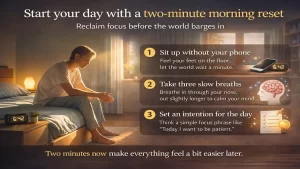
1 Two-Minute Morning Habit That Improves Productivity All Day
The two-minute reset your brain responds to immediately
Research on attention shows that the first moments after waking are unusually powerful. Your brain is highly malleable—like wet cement. Whatever you put there shapes the rest of the day.
If the first input is notifications and news feeds, your nervous system learns one rule: react fast. That’s why neuroscientists increasingly point to a simple counter-move: two screen-free minutes right after waking, used to breathe and set intention.
The idea is straightforward. Sit up. Feet on the floor. Phone out of reach. Breathe slowly for a minute, then choose one thing you want your brain to prioritize today. Not a full plan—just a direction.
Studies from multiple research labs show a consistent pattern: people who delay digital input in the morning tend to have lower cortisol levels and more stable focus hours later. Even a brief pause helps shift the brain from “threat scanning” to “directed attention.”
Think of it like this: if you don’t choose what runs first, your brain defaults to an anxiety-driven program. Two quiet minutes are enough to interrupt that automatic script.
Why this tiny pause works
Slow breathing activates the parasympathetic nervous system—the body’s natural brake pedal. A longer exhale tells your brain that there’s no immediate danger. In that calmer state, a simple intention (“be clear,” “be patient,” “finish the draft”) actually lands.
Researchers studying top-down control describe this as your planning brain—the prefrontal cortex—setting priorities before emotional reactivity takes over. Public science communicators like Andrew Huberman often explain it this way: whoever speaks first in the morning tends to guide the rest of the day.
Brain-imaging studies back this up. Even short, consistent intention practices are linked to stronger communication between the prefrontal cortex and the amygdala, the brain’s alarm center. The line between “I’m overwhelmed” and “I can handle this” isn’t just psychological—it’s neurological.
What the habit looks like in real life
This is the version people actually maintain:
Alarm rings. Sit up. Feet on the floor. Phone stays face down or in airplane mode.
60 seconds: breathe in through the nose, out slightly longer than the inhale.
60 seconds: quietly name one task or moment today and how you want to show up for it.
Nothing poetic. Nothing performative.
“Team meeting: calm and clear.”
“Morning with the kids: patient.”
“Writing block: focused.”
That’s enough. You’ve told your brain what matters before the world starts shouting.
How to keep it simple (and stick with it)
The biggest mistake is turning this into homework. You don’t need journaling, stretching, affirmations, and a perfect sunrise. Consistency beats complexity every time.
Anchor the habit to something that already happens: the alarm sound, the first light in the room, your partner getting up. Miss a day? Fine. This isn’t about perfection—it’s about trend.
Over time, many people notice something subtle but important: the urge to check the phone immediately weakens. Not disappears—just quiets down. The volume drops.
A helpful way to remember it is as a tiny “startup script”:
One place (bed edge or chair)
One breath pattern
One simple sentence
When those run, your brain gets a clear message: you’re in charge, not the notifications.
Why two minutes can change the whole day
We’ve been trained to believe only big changes matter. Early wake-ups. Thirty-day challenges. Total life overhauls. But the nervous system responds better to small, repeated signals.
People who adopt this habit rarely describe dramatic transformations. Instead, they say the day feels less jagged. Interruptions don’t escalate as fast. One stressful email doesn’t dictate the next six hours.
Over time, identity shifts. You’re no longer someone whose day just happens. You’re someone who, once each morning, pauses and chooses how to show up. That’s not hustle productivity—it’s alignment.
When your attention belongs to you, even a messy day can still feel like progress instead of defeat.
Frequently Asked Questions (FAQs)
What if I only have 30 seconds, not two full minutes?
Use them. Take a few slow breaths and choose one clear intention. Short is always better than skipped.
Can I do this lying down?
Yes. Sitting up sends a stronger wake-up signal, but if you’re exhausted or unwell, lying down works fine.
Is this meditation?
Not really. It’s closer to a focus warm-up—using breath and intention to orient your mind.
What if my thoughts keep drifting to my to-do list?
That’s normal. Each time you notice, gently return to your breath and your one sentence. The return is the practice.
How long before I notice a difference?
Some people feel calmer within days. More consistent changes in focus and reactivity usually appear after two to three weeks of semi-regular practice.