What lay hidden for a century inside a Canadian bank vault is now reshaping conversations about heritage, inheritance and history.
Wrapped in cloth and silence, jewels once carried out of a collapsing empire have re-emerged — including a diamond long believed lost forever.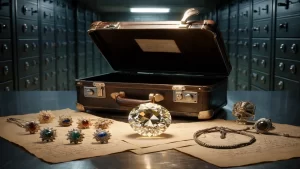
1 Historic Diamond Found — Inside Old Habsburg Suitcase
A suitcase that escaped a fallen empire
The story begins with the collapse of the Austro-Hungarian Empire at the end of World War I.
As monarchies dissolved and borders shifted, Empress Zita of Bourbon-Parma, widow of Emperor Karl I of Austria, faced exile.
Rather than fleeing with ceremonial regalia, she chose practicality. Into a modest suitcase, she packed private jewels — portable wealth that could be hidden, transported or sold if survival required it.
Each piece carried both monetary and emotional value: a discreet financial reserve and a fragment of dynastic memory.
Escape during wartime Europe
In 1940, as German troops advanced through Belgium during World War II, Zita and her children were forced to flee again.
Their route led through Portugal, then across the Atlantic to Canada. They eventually settled in Quebec, where the French language offered familiarity and a degree of cultural comfort.
Behind their modest exile life, however, the imperial legacy was still being carefully protected.
A century in a Canadian bank vault
Shortly after arriving in Canada, Zita placed the suitcase inside a bank safe deposit box. She left strict written instructions: the contents were not to be opened until one hundred years after Emperor Karl’s death in 1922.
That date arrived in 2022.
For decades, descendants quietly paid the rental fees without breaking the seal. The suitcase remained untouched through wars, political upheaval and generational change — a time capsule of imperial Europe.
What was inside the suitcase?
When the vault was finally opened, the jewels were found carefully wrapped and remarkably preserved.
Among brooches, insignia, decorative pins and colored gemstones, one object stood out: a large pale yellow diamond cut in an unusual historic style.
Experts quickly focused on its distinctive double rose cut — a shape associated with Renaissance craftsmanship.
Comparisons with archival descriptions and court portraits led to a dramatic conclusion: the stone was almost certainly the long-missing Florentine Diamond.
The Florentine Diamond returns
For more than a century, the Florentine Diamond existed somewhere between legend and mystery.
Weighing nearly 137 carats, the pale yellow gem had passed through European ruling houses before entering Habsburg possession. After the fall of the monarchy, it disappeared from public record.
Rumors suggested theft. Others claimed it had been secretly recut and sold.
The Canadian discovery suggests something far simpler: it never left family hands.
Authentication through portraits and records
Historians and gem experts did more than examine the stone’s weight and cut.
They cross-checked:
Old imperial portraits
Black-and-white ceremony photographs
Court inventories
Brooches and star-shaped decorations seen in paintings reappeared gem-for-gem in the suitcase. The diamond’s characteristics matched historical descriptions of the Florentine.
The collection was not a reproduction. It was original imperial property, preserved in exile.
Who owns an imperial diamond today?
The rediscovery raises complex legal and ethical questions.
Is the diamond private property inherited by Habsburg descendants?
Does it qualify as cultural heritage tied to modern Austria or other successor states?
Does Canada, where it was legally stored for decades, have a role?
The gem now sits at the intersection of inheritance law, international heritage claims and public expectation.
What could happen next?
The heirs have reportedly expressed interest in public exhibition rather than returning the jewels to permanent secrecy.
A first exhibition in Canada is being considered — a symbolic gesture toward the country that sheltered the family in exile.
If displayed, the diamond would require:
High-level security
Specialized conservation oversight
Strict lighting controls
Insurance at exceptional valuation
Institutions often rotate historic gems on and off display to protect fragile settings. With its rare historic cut, the Florentine would demand particularly careful handling.
Why this gemstone matters beyond price
On the open market, a 137-carat diamond would command extraordinary bids.
But specialists argue its historical value may outweigh any auction result.
The stone represents:
Renaissance-era craftsmanship
Imperial European politics
The collapse of monarchies
The refugee experience of dethroned royals
It transforms from luxury object into historical witness.
Understanding key details
Storage location: Canadian bank safe deposit
Sealed period: 100 years after Karl I’s death
Primary discovery: Pale yellow Florentine Diamond (~137 carats)
Additional items: Brooches, insignia, pins with colored stones
Possible future: Public exhibition and further expert review
A broader reflection on hidden legacies
The rediscovery resonates beyond royal history.
Across Europe and North America, families still uncover wartime suitcases, hidden valuables and forgotten archives. Most contain letters or savings, not imperial diamonds — yet they reveal similar stories of displacement and survival.
The Habsburg suitcase shows how an object can evolve:
From financial safeguard
To guarded family secret
To public historical artifact
And with its return, one question remains at the center:
Who truly owns the remnants of an empire — the descendants, the nations that replaced it, or history itself?
FAQs
Was the Florentine Diamond really lost?
For over a century, its whereabouts were unknown. The Canadian discovery strongly suggests it remained in private Habsburg custody rather than being stolen or sold.
How large is a 137-carat diamond?
One carat equals 0.2 grams. At nearly 137 carats, the Florentine would weigh more than 27 grams — unusually large for a single gemstone.
Why is the rose cut important?
A rose cut reflects Renaissance-era techniques. Altering it would likely damage both historical authenticity and value.
Could the diamond be sold at auction?
Technically yes, if legally confirmed as private property. However, heritage considerations and public interest may influence future decisions.
Where might the diamond be displayed?
A public exhibition in Canada is reportedly under consideration, potentially followed by international museum collaborations.